Should You Turn On the Open to Work Badge on LinkedIn?
Why the same badge helps one person and hurts another
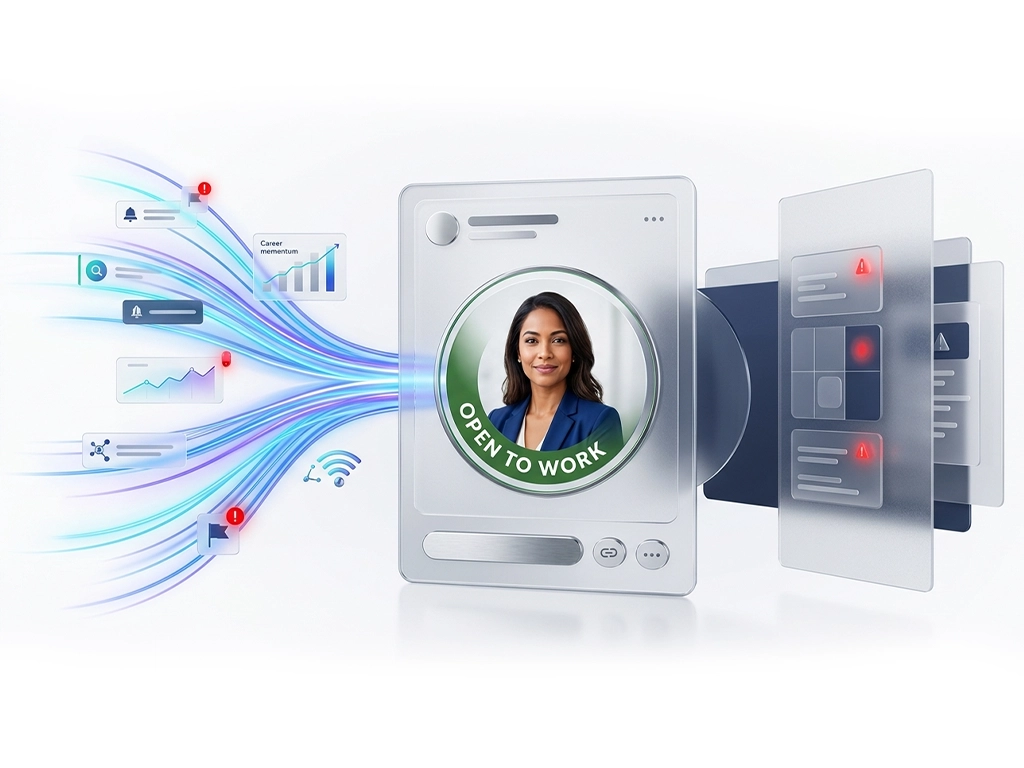
Ask this in any job search group and you will start a fight. Half the room swears the green Open to Work ring filled their inbox with recruiters. The other half ripped it off within a week, certain it made them look desperate.
So who is right? Here is the honest answer. The badge does not mean one thing. The same green ring helps one person and quietly hurts another, because the badge is not the signal. The recruiter who reads it is.
The real debate
You are out of work, or quietly done with a job that is draining you, and LinkedIn offers you a button that tells recruiters you are available. It should help. Then a colleague mentions they saw your banner, or your exciting new message turns out to be an insurance pitch, and the doubt sets in.
Both camps are loud about it.
The day I turned it on I got three recruiter messages. It works. Stop overthinking a free signal that tells people exactly what you want.
The believer
I took it off after a week. All I got was spam and insurance pitches. It felt like wearing a sign that said please help me.
The skeptic
Same green badge. Opposite outcomes. That alone tells you the badge is not the thing doing the work.
It looks like a simple choice
On the surface there are two options, and they look obvious.
Visible
Wear the badge
You are telling recruiters, and if you have set it to public, your whole network too, that you are available and actively looking.
Invisible
Stay bare
You look like every other profile quietly browsing. No one can tell you are even looking.
A clean yes or no. Except the same choice lands completely differently depending on who is looking, and why.
What a recruiter actually sees
A recruiter is almost never just looking at your profile. They are doing one of two very different things, and the badge means something different in each.
When a recruiter is actively sourcing, scrolling search results for someone to fill a role, the badge is a green light. It says you will probably reply, you are available now, and they will not waste a week chasing someone happy where they are. Here it helps you. It gets you onto the shortlist.
When a recruiter is evaluating you specifically, for a role you applied to or got referred for, the math changes. Now they are forming an impression, and a few will read visible availability as urgency, or quietly wonder why you are still looking. The badge did not change your qualifications. It changed the story around them.
The badge rarely hurts you with the recruiter who is looking for you. It only risks the one who is already judging you.
When showing it helps, and when it hurts
Showing it tends to help when
- You are early in your career and need to be discovered, not evaluated.
- You are already out of work, so there is no impression to protect.
- You are in a high volume field where recruiters source fast and availability wins.
- You do not have a strong referral network, so being found matters more than being chosen.
It can work against you when
- You are senior or specialized, where recruiters want to feel they are choosing you, not catching you waiting to be picked.
- You are still employed and do not want that signal reaching the wrong people.
- You are in a small, prestige driven field where everyone notices who is looking.
- You are already getting strong inbound interest and do not need the exposure.
Why people report completely opposite experiences
Part of it is the recruiter context above. The rest is simpler. Showing Open to Work is not even one thing. Some people broadcast it to their whole network. Others quietly share it only with recruiters, so it never touches their public profile. Two people can both say they used Open to Work and be describing completely different experiences. That is why the advice you hear is so contradictory. They were never running the same experiment.
Our take
For most people, the fear is backwards. Looking a little too available is a small risk. Staying invisible while you genuinely need to be found is a much bigger one. The desperation worry is real, but it mostly applies to a narrow group: senior, specialized, or still employed. Everyone else is overthinking a green light.
And if the perception still worries you, it is not all or nothing, you can control who sees it. Just do not let the fear of looking available stop you from being found.
The state nobody talks about
Here is the uncomfortable part. Most people do not lose the search because of the badge. They lose it because they cannot see what their own search is doing.
Everyone treats this as a choice between visible and invisible. There is a third state, and it is the most common one of all. Unclear. You flip the banner on, a few messages trickle in, you lose track of which led anywhere, and a month later you still cannot say whether it helped. The badge was never the problem. Not being able to read your own results was.
The fix is unglamorous and it works. Keep your whole job search in one place: every job, where it came from, its status, and a quick note like badge on or badge off. Namirasoft Job Arranger does exactly that, so the pattern becomes something you can see instead of guess. Once everything lives in one view instead of scattered across your memory and three inboxes, the things that usually stay invisible, like whether the badge is doing anything for you, finally show up. The badge stops being a guess, and you can tell whether it is earning its place.
The short version
The Open to Work badge does not mean one thing. The same ring helps one person and hurts another.
- It depends on the recruiter. A green light to the one sourcing you, a question mark to the one judging you.
- It helps most when you need to be found, and risks more when recruiters read for selectivity.
- People report opposite outcomes because using Open to Work is not even one thing.
- Whatever you choose, keep your search in one place so you can tell what is actually working.